November 30, 2018

Some Musings on Wood Handled Tenkara Rods

Call me old fashioned, but I still like craftsmanship. I certainly wouldn't call myself an artist, but having built many western fly rods I can appreciate what it takes to make a functional piece of art such as a custom fly rod. When it comes to tenkara rods however, the usual things that define a custom rod do not apply. On tenkara rods there are no reel seats, no guide wrappings, no ferrel wraps, and on many, no winding check wrappings. For the most part, when it comes to tenkara rods, what is left for the true artist is the handle.

You can be an artist with western rods. (No, I didn't make this rod!)


Since I started fishing tenkara (January 2012) there has been an explosion of rods available to tenkara anglers. Many have been me-too rods; rods that come from Alibaba with a logo change and then sold as a great new line of rods. Other tenkara rods have been partially designed from the ground up, tested, and then modified to increase their action and improve the casting/fishing experience. Finally, there are a few rods that are groundbreaking, truly new designs with many hours of testing and modifying until the ultimate goal is achieved. Still, even with these last group of rods there seems to be little artisan/craftsmanship. The trend now days is to use foam for handles, not even cork. I know it's hard to find and somewhat expensive to buy high quality cork, but I don't care what you say, a foam handle will never stir my soul like a well executed cork handle will. And for that matter, although a custom cork handle is to be admired, in my book it still takes second place to wood.

Bottom to top: TUSA Ebisu, Nissin Air Stage Fujiryu 360, Sakura Seki Rei, Oni Itoshiro 340, Oni Type-1 Bamboo.


A wood handles gives a rod its own personality. They can be simple in shape, such as on the Sakura Seki Rei, or they can be more complex, as on the Oni Type-I Bamboo. Still, any wood handle, as long as it has been done well, gives a rod unique characteristics that is not achieved by cork, and certainly not by foam.

With wood, each rod is different. No grain pattern, even from the same wood blank, is the same. Also, as the rod is fished the wood takes on the oils from the users hand, and in effect absorbs into itself all the fishing adventures it has been used on. Wood develops a patina, cork gets dirty, and foam, well, foam just gets smelly.

Are there any downsides to wood, of course, there are downsides to everything. The main two I can think of are cost and weight. Wood handles, especially really great ones, like ones on the Oni Itoshiro 340, are true works of art. To get that level of quality it's going to cost some simoleons. Secondly, wood weighs more than cork and foam, and so the rod will weigh more. Still, when done well, a wood handle is a thing of beauty to be celebrated and prized. It will show you where you have been, and continue to please you for years to come.

With that said, do I wish my favorite tenkara rods, the TenkaraBum 36 and 40 had wood handles? No. That would change the characteristics of the rods too much. Do I love the handles on the TB36, TB40, Karasu, Tanuki XL-1, or Shimano rods? No, as they're lifeless, impassionate foam. How can you love foam? Do I wish Tenkara USA would bring back the Ebisu? You bet! It was heavy, but you have to admit, it had class!




November 25, 2018

Slipping in a Little Fishing over the Holiday

I have been on-call over the holiday weekend, and so I can't go very far from the hospital. Fortunately, one of the streams that I normally fish in the winter is not far from the hospital and cell phone coverage is just enough that I can still receive a text from the ER or hospital operator.

I hate just sitting around waiting for the next bleed to come in or the next patient call, so I thought I'd slip out for a minute to fish. My personality type won't let me go for very long or too far, but a few minutes in the water is a welcome help to decompress the stress.


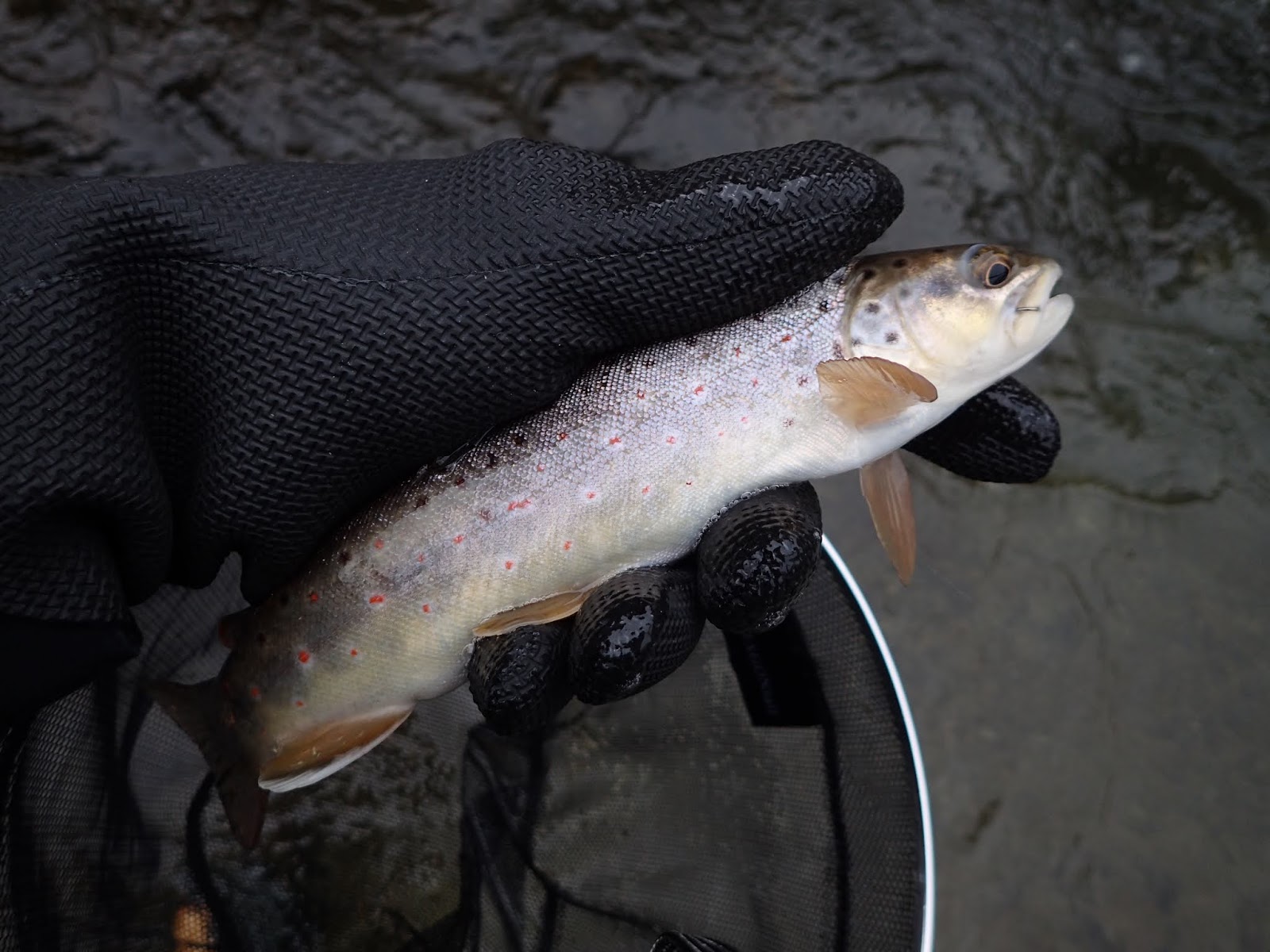
The sky was cloudy and grey, but the water was nice, with a temperature at 6°C (42°F) and the air was a warm 8°C (46°F). To my delight there was very little breeze. The trout have all gone into winter mode, holding tightly to the bottom in pockets or under tree snags. They won't go far for a fly, so I have to get the fly to hit them on their noses.


I fished for 50 minutes and hooked four nice browns. I scared a few while wading upstream, which means I needs to work on my presentation, as I should have taken those ones I scared. But it's early in the winter season and I'm still transitioning from summer/autumn tenkara to winter fixed-line fishing.


The fly that worked for three of the trout was a #12  Egan's Red Dart, but a synthetic Prince also took one of the fish.


It was nice to get out of the house, and I look forward to being off-call so I can get back out and fish more freely without my ball-and-chain (AKA, cell phone).


November 22, 2018

How About Another Book for Christmas!

Christmas and gift giving season is coming up fast, and if you are like me, my family is often at a loss on what to get me. I don't need another tie. Tenkara stuff is not in their vocabulary, and besides, I tend to buy my own tenkara stuff. Gift giving can sometimes be pretty challenging.

But here's an idea, how about a great book! It's not a tenkara book, rather it's a fly fishing book that can be incorporated into tenkara style techniques. It reads well, illustrates flies and techniques applicable to tenkara anglers, and is not too expensive.


The book is Fly-Fishing Soft-Hackles (nymphs, emergers, and dry flies) by Allen McGee; 2017 Stackpole Books.

I have all the books on soft hackles that Syl Nemes and Dave Hughes have written. They are great and are some of my most used references. Even though they were top patterns in the old days, soft-hackles are not often fished by western fly anglers nowadays, and that's a shame. It seems that Euro nymphing and streamer fishing seem to be dominating fly fisherman for the past decade. Those are fun ways to fish, but I like soft hackles. This new look at these classic style of wet flies is fun to read and frequently brings a head nod and a "that's interesting" from my mouth.


The book presents thoughts on bringing progressive materials and methods to some old fly designs. It outlines soft hackle flies which mimic various insect types. Fishing presentations are also included, and although the author uses a western fly rod, the techniques he shows are very useful to those of us who have embraced tenkara and fixed-line styles of fishing. In addition, there are plenty of patterns shown to stuff your fly boxes.

Anyway, it's a nice book and would make a great addition to any fly fishing or tenkara library. Happy gifting!


November 18, 2018

Oni Itoshiro 340 review

This past Oni School, I had the opportunity to obtain a new rod from Masami Sakakibara for use with a light level line and unweighted kebari on smaller streams. It is the Itoshiro 340. Like the other Oni rods that I own, the Itoshiro 340 is a premium tenkara rod that has to be cast to be appreciated.

The Itoshiro 340 is basically a shorter version of the Oni Type-I rod, as the parts are interchangeable. This is analogous to the Oni Type-II and Type-III rods which likewise have interchangeable parts with each other.

The rod is charcoal grey/black in color, with unsanded blank segments. It is simple in it's marking and other than the handle looks exactly like a Type-I Oni rod. The segments have a fine gold ring accent on all but section 1, the tip section.  The rod came, like my other Oni rods, with only a rod sleeve. No rod tube is provided.

My rod was signed by Oni between the rod designation and the handle. This is not usually for his rods, but if you ever meet him and have your Oni rod with you he will be happy to sign it.


My Itoshiro 340 has a wood handle, which is made of karin wood.  In Japan, the tree called karin (花梨; rarely, also 榠樝), Pseudocydonia sinensis or the Chinese quince, is a deciduous or semi-evergreen tree in the family Rosaceae, native to eastern Asia in China. It is often used in making furniture and musical instruments. I chose this wood because of its deep rich color and prominent grain pattern.

The handle is 25 cm in length, camel or gourd shaped and has a smooth satin finish. It is very beautiful and is perfect in fit and finish.


The tip plug is black nylon plastic and fits securely. The butt cap is small, gold colored metal, is knurled and has a coin slot. A small air hole is present.


The lilian is fine red material, much finer than the lilian on the Type-II or III. The glue joint is small and perfect. The entire rod can be disassembled for drying and cleaning.


Here are some measurements:

Fully collapsed: 60.5 cm
Fully extended: 349 cm
Weight (without tip plug): 111.5 g
CCS/RFI: 10.5 pennies/3


The rod has perfect balance in hand, and despite having a heavy dry weight it feels like you're holding nothing at all. I know this seems like a contradiction, but it's true. For a tenkara rod, this rod is heavy. But it balances perfectly and feels amazing!

The casting stroke is tip flex, like the Type-I. Sure, the rod is a soft rod, after all it has a Rod Flex Index of only 3, but don't let this measurement fool you. It's lower RFI comes from the flexible upper sections, but the lower segments have more stiffness. This is in contrast to the Type-III which has an RFI of 3.5. This is because the tip segment is thicker and less flexible than the Itoshiro, but the midsection of the Type-III is more flexible. When I cast both the Itoshiro and Type-III alongside each other I much preferred the Itoshiro for my casting style.

Fishing the rod is pure joy. It casts as only an Oni rod casts. Casts are smooth and precise. I used both  #2.5 and #3 fluorocarbon level lines and the rod didn't care which one I used. I first fished the rod on a spring creek that has a low but steady flow and clear water. The cutthroat that populate this creek can see you a mile off, so stealth is paramount. The rod placed the fly exactly where I desired and I took many fish within a 45 meter stretch.


I only fished this rod with 6X tippet and unweighted subsurface kebari. I'm sure it could throw a weighted nymph, but I don't think it would be at peak performance doing so. This is a Japanese tenkara rod made specifically for Japanese style tenkara (but I bet Bluegill would be a blast on this rod).


Just for information, although my rod has a wood handle, the Itoshiro is being released in a EVA foam handle version by TeamOniUSA. This rod will be lighter and less expensive. I'm sure it will be a great rod as well, but there is something to be said about the craftsmanship and uniqueness of the wood handle.

Conclusion: Like the Oni Type-I, the Oni Itoshiro 340 is phenomenal! It is a great smaller stream finesse rod, and for me feels/casts better than the Type-III. Sure it's a little heavy but you can't tell when using it. It looks and casts like a dream and I think anyone who obtains one of these rods will be very, very pleased!

Disclaimer: My opinion regarding this rod is just that, my opinion. Your opinion may differ.  Also, your rod may not have the same length, issues, or functionality as my rod. There are variations between rods, even in the same production run. No description can fully tell you how a rod feels or fishes. For this, you must personally hold, cast, and fish the rod then make up your own mind.

I purchased this rod, and have no affiliation with Masami Sakakibara, or Team Oni USA. 


November 9, 2018

Daiwa Master Tenkara L 3.6 m rods


Daiwa has announced a new tenkara rod to their already impressive line up. It is a "master" rod, being designed and produced specifically for advanced tenkara anglers.

No one has seen the rods yet, as they have not been released to the public, but tenkara researcher extraordinaire, David Walker has found out some information regarding the new rods. Here is what David says:

 "Last time round Daiwa introduced the Expert Tenkara L & Expert Tenkara LT [エキスパート テンカラ L & エキスパート テンカラ LT ] rods.

The Master Tenkara L [ マスター テンカラ L ] rods are now listed on their webpage this time round, with release date of Nov 2018 [2018.11 デビュー]. Two rods, both 3.6m in length. The LL 36 & LT 36.

The rods only have 4 segments. Thus a longer collapsed length of 99.2 cm, about 1m. Weight 78g and 80g.

Pricey rods, both list for 46,000 JPY ~ $408. I did not find them listed yet on any commercial websites. Maybe retailers will list them at lower than Daiwa’s list price.

Developed by Katayama Etsuji-san tester [片山悦二さんテスター ]. Who calls it a “中継テンカラ竿”, Which I am guessing means a mid flex (middle segment) rod. The same 中継 term is used in the description of the Expert L tenkara rods.

Each rod has a different type of tip. First segment. LL 36 (Tubular tip), LT 36 (mega top tip). Which from the description indicates the difference is to enhance the use of light level line or tapered line, and why they should work better."


Here is the full information page from Daiwa. 

I'm looking forward to casting and fishing with this rod. It's expensive, but having fished Daiwa's other tenkara rods, I bet it's worth it!


November 7, 2018

Royal Gorge Anglers Tactical Tenkara Nymphing Line

I recently had a welcome communication from Paul Vertrees of Royal Gorge Anglers regarding a new tactical nymphing line that he has made. I use a couple of Paul's lines when I nymph as it is, but I was excited about the new line. He graciously sent me one to try out.

Here is what Paul says about the line: "When I was designing this line, I took what I knew about archery (arrows), atlatl darts, and spears, and applied it to the span of a nymphing line.  On a greatly reduced scale, it's still tapered weight-forward just like an arrow, atlatl dart, or a spear.  Although it's swinging instead of flying forward, the WF design still lends itself quite well to casting nymph rigs (weighted or unweighted) in one simple, smooth forward-moving arc.  I feel it does this much better than one single, constant diameter length of level line.  Using bi-color segments and adding "Depth Dots" made this line even better, as you now can have consistent depth control and visual connection in all light conditions."


My Tactical Tenkara Nymphing (TTN) line is 12' and matches perfectly with my Daiwa 43MF, my main dynamic nymphing rod. I took the line to the Henry's Fork to fish double tungsten bead head nymph rigs for fall browns and large mountain whitefish. The weather has been cold and there's always a breeze blowing on the Henry's Fork. It's a great testing ground for lines and flies.

The line casts wonderfully. The weight forward design, along with the fluorocarbon line, really flies through the air carrying the heavy nymphs without any hesitancy. The breeze made no difference in casting the line.

The sky was overcast with low light conditions, but the line's three "depth dots" really glowed nicely making it easy to track. Because you can see any one of the depth dots at all times, any hesitation is readily noted and so hook sets can be quick. This is just what is needed for tactical nymphing.

The line is extremely well made and appears to be robust. I'm confident mine will last many seasons.

I think Royal Gorge Anglers and Paul have another winner here. If you are into fixed-line tactical/dynamic nymphing then you should look into getting one of these TTN lines. It may be just the ticket to up your game!