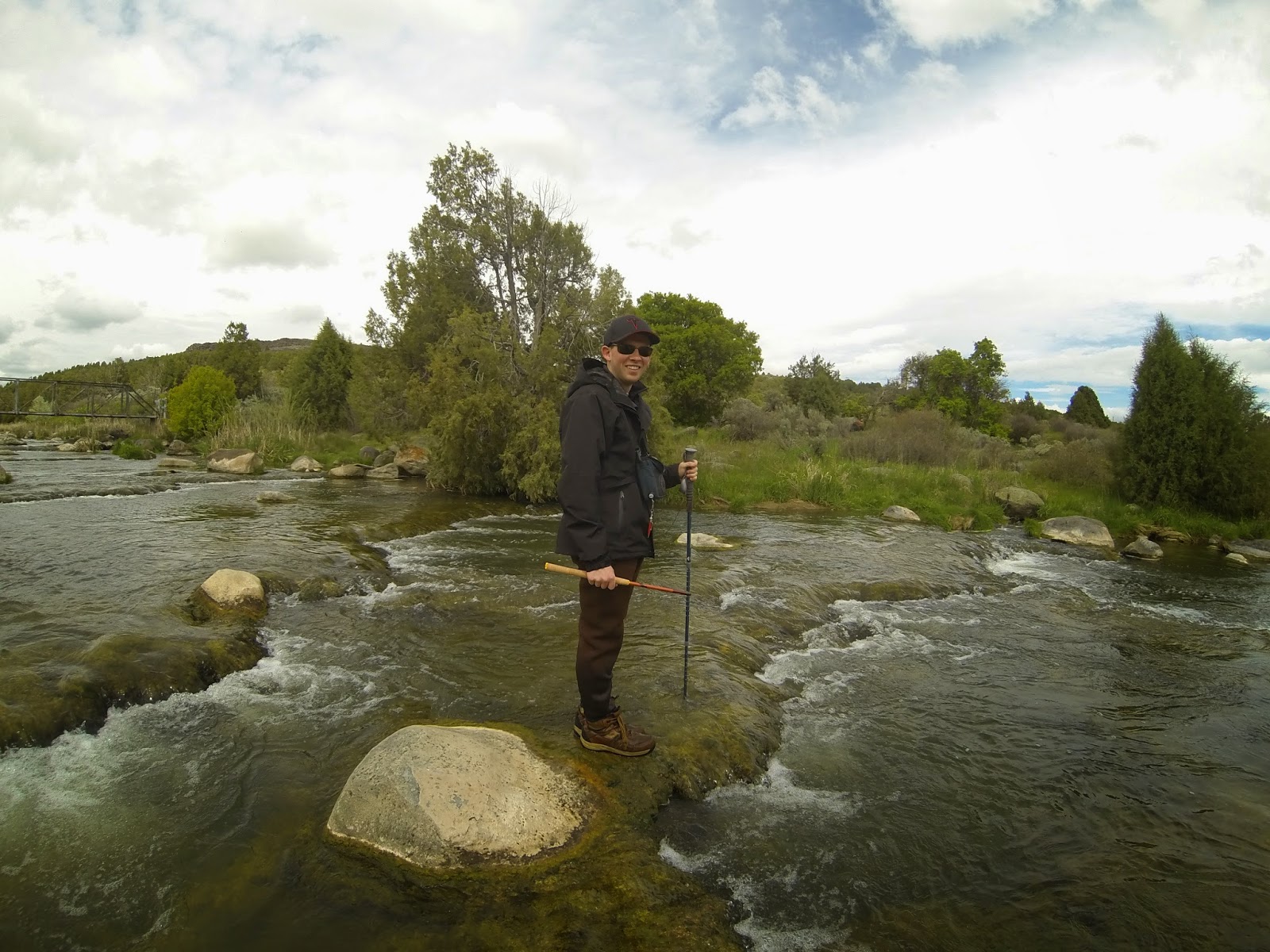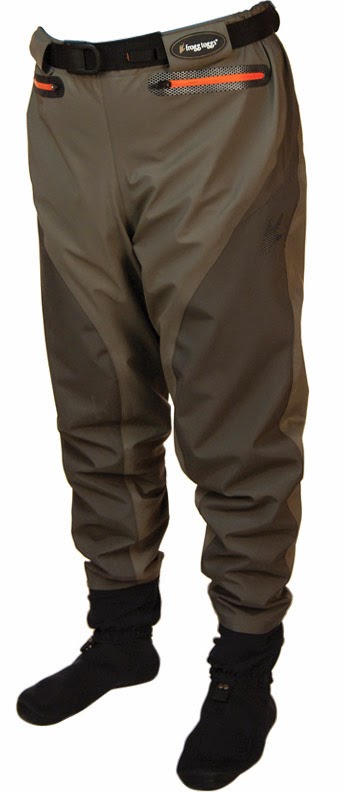
In February of this year I wrote a little about using unconventional tenkara techniques on small streams. I reviewed some techniques and tools that are useful when pursuing trout in very tightly brushy waters. I entitled that essay The Short Game.

When I started fishing very small waters years ago there were only a couple of short rod choices, but over the last year it seems that every one is introducing their version of short rods. I have used many, but not all. Some are pretty good; some are poorly executed (IMO). The good news is that most all can expand your repertoire of waters.


In this post I would like to show some of the rods that can be used to help you get into the tightest of corners. Just to clarify, the rods I present here are rods I've actually used. They are in no particular order.

Tenkara USA Rhodo
This rod is Tenkara USA's shortest rod. In its shortest configuration it is 270 cm. It is well made, aesthetically pleasing, light in hand and has a very functional flex profile -- stiff enough for all but the largest fish in the tightest waters but not too stiff. It casts a #3.5 level line beautifully. One advantage is that it can be extended to 297, then 320 cm when fishing more open sections. Another is it's thoroughly thought out design. It is readily available from Tenkara USA. It is expensive compared to other short zoom rods, however.
The CCS values for the Rhodo are 15 pennies at 320 cm, 15.5 pennies at 297 cm, and 15 pennies at 270 cm. This gives it a RFI of 4.3, 5.2, and 5.6 for 320, 297, and 270 cm respectively.
------------------------------------------------------------------------------------------------------------------------

Nissin Pro Spec 2-way 320
This rod is very comparable to the TUSA Rhodo. It too is well made, has a very nice flex profile and casts a #3.5 line beautifully. In its short configuration it is 270 cm. It too will fight fish well in tight quarters, but it not too stiff to make casting unpleasant. It can be extended to 320 cm for more open sections. One advantage it has over the Rhodo is that the Pro Spec 2-Way 320 comes in two different flex ratings -- 6:4 and 7:3. Mine is a 7:3. Nissin rods seem softer in action that what is advertised. The 7:3 casts like a 6:4. I suspect the 6:4 casts more like a 5:5. Another potential advantage over the Rhodo is that it costs less and is made in Japan.
In the long position (320 cm configuration) the rod has a Common Cents System rating of 14.5 pennies. This gives it a Rod Flex Index rating of 4.6. In the short position the rod is 15.5 pennies, and thus an RFI of 5.6.
------------------------------------------------------------------------------------------------------------------------

DRAGONtail Komodo
This is DRAGONtail's entry into the short rod scene. Like all of DRAGONtail rods, it seems well made with good quality components. It too is 270 cm at its shortest usable length and extends to 315 cm for more open areas. The finish is a pleasing flat graphite but the action is pretty stiff. It works best with a short furled line, but I find a furled line to be problematic when fishing small streams. Here's the argument. When fishing small streams you tend to snag the line a lot: in trees, in bushes, in underwater logs and rocks. If you step forward to retrieve the fly then you scare the fish. If you pull the snag out then the furled line tangles up. With a furled line you can spend a considerable amount of time unraveling the tangles. Besides, furled lines are heavy. I prefer level lines for small streams.
The CCS rating for 270 cm is 24 pennies; an RFI of 8.9. For its 315 cm it's 26 pennies; RFI of 8.3. That's pretty stiff.
------------------------------------------------------------------------------------------------------------------------

Nissin Yuyuzan 2-Way 290ZX
This is a short keiryu zoom rod that fishes in both 240 and 290 cm lengths, thus giving a tight quarters guy like me some choices. It has quite a flexible tip but it stiffens up pretty fast -- maybe too stiff for some. Being 240 cm, it allows even tighter creeks to be fished. I have a number a small streams that 270 cm is just too long -- you may be able to hook a fish using the sling shot cast but when you try to set the hook you find out you can't, you keep hitting tree branches. In spots like this a 240 cm rod can save the day.
I'm still not sure if I like this rod, as it's pretty stiff, but I really like it's lengths and how well it fights larger trout. At 240 cm it has a 19 penny rating (RFI 7.5). At 290 cm it is 22 pennies (RFI 7.4). Those numbers don't seem that stiff, but they don't tell you the truth: that the rod is stiff while the tip is very flexible. That's why the RFI numbers are in the mid-7's.
-----------------------------------------------------------------------------------------------------------------------

Tenkara Rod Company Cascade
This 240 cm rod is really stiff and inflexible. It is so stiff that traditional casting is a challenge. It does very well with the sling shot cast however. There are a couple of other things I don't like about it. First, it is bright blue. Maybe I'm fooling myself, but since short rods demand that you get really close to your quarry, you need to be even more stealthy than usual. This rod is anything but stealthy. It is so bright that you might as well have a sign above your head that says PREDATOR. Now, maybe that's not quite fair. After all, when I used the Cascade I caught plenty of fish. But still, I don't like the color.
The second down side is that this is sort of an expensive rod, given it's length. It costs more than some better rods and I'm not quite sure why.
On the Common Cents System it is a stiff 23 pennies. This gives this rod a very stiff Rod Flex Index of 9.6! That puts the rod well into the 8:2 action.
------------------------------------------------------------------------------------------------------------------------

Shimotsuke Kiyotaki 24 and 27
These little keiryu rods are far from the prettiest, but they have caught me more fish than all the rods previously mentioned -- combined. I have to say, these little guys are some of my favorites. They are inexpensive yet highly portable and very functional. They have a very useful flex profile and cast a short line well. They also have plenty of lower rod stiffness to fight the "big boys" out of the underwater snags. The walls of these rods are thin and I have broken two of them, both times my fault. The walls are not as thin as the Pocket Mini 270 but as with all rods, be careful pulling back hard.
The CCS rating for the Kiyotaki 24 is 15 pennies. That's a RFI of 6.3. The Kiyotaki 27 is a 20 penny rod. That's an RFI of 7.4.
--------------------------------------------------------------------------------------------------------------------------

Nissin Fine Mode Kosansui 270
This keiryu rod is a wonderful short rod for small streams. Of all the rods fore mentioned, I'd have to say this rod is the best balanced. It casts a short level line beautifully and is only 37 g in weight. It has a beautiful finish and top notch design. It is a little long when fully collapsed but hey, I can over look that. This is a great rod. If I didn't already have a Soyokaze I'd buy one of these rods.
It's CCS rating is 19 pennies. It's RFI is 7.0.
------------------------------------------------------------------------------------------------------------------------

All Fishing Buy Wakata 270
Yes, the Wakata. I don't know how many tenkara rods are sold per year, but I bet Allfishingbuy, the Staten Island internet fishing company with the funny name, sells a lot -- all over the world. A few years back when tenkara people were saying there was no such thing as a 270 cm tenkara rod, Allfishingbuy was selling them.
The Wakata is a nice rod. I like its flat black carbon finish and its flex profile. It is a little long when collapsed, the longest of all these rods, and the handle is a less than traditional is shape. But I like the rod. It's hard to beat the price and replacement parts are crazy cheap. If you want a short rod that is a workhorse and one that wouldn't make you cry if you broke it tripping over a log jam, then this is the rod. It has a CCS rating of 15 pennies and an RFI of 5.6.
-------------------------------------------------------------------------------------------------------------------------

Daiwa Soyokaze 270
Finally we come to the Soyokaze. This is the most amazing rod. It was my first 270 cm rod and has to be my overall favorite. It is light in the hand, is well balanced, and casts so beautifully in tight quarters. The tip is very flexible making modified roll casts a cinch, and sling shot casts a piece of cake. It is a little heavier than the Kosansui 270 but it is also a little beefier. Look around on the internet, the Soyokaze 270 has caught some pretty large fish -- into the upper teens. This rod is out of production, and those that own one are not likely to sell theirs. But if you ever see one come up for sale, buy it. Yeah, it's that good.
The Soyokaze 27 has a CCS of 17.5. It's RFI is 6.5. BTW, the Soyokaze 24 is a pretty great little rod too. It's CCS is 13 pennies, with an RFI of 5.4.
--------------------------------------------------------------------------------------------------------------------------
So there you have it, a few 270 or shorter rods for tight, brushy creeks and streams. Not every body likes this type of fishing since it is really hard and the fish are not usually very big. But I love this stuff. What's your poison: Henry's Fork for 20" browns on a #20 PMD dry or no-name creek, surrounded by willows, for 6-8 inch native cutthroats? I'll take the little creek any day, no questions asked. To me a short rod + a short line = maximum fun!
I'll be reviewing some other short rods soon, so stay tuned!
You can buy the rods I talked about from Tenkara Bum, Tenkara USA, Tenkara Rod Company, Dragontail Tenkara, Allfishingbuy, as well as some direct Japanese importers.


When I started fishing very small waters years ago there were only a couple of short rod choices, but over the last year it seems that every one is introducing their version of short rods. I have used many, but not all. Some are pretty good; some are poorly executed (IMO). The good news is that most all can expand your repertoire of waters.


In this post I would like to show some of the rods that can be used to help you get into the tightest of corners. Just to clarify, the rods I present here are rods I've actually used. They are in no particular order.
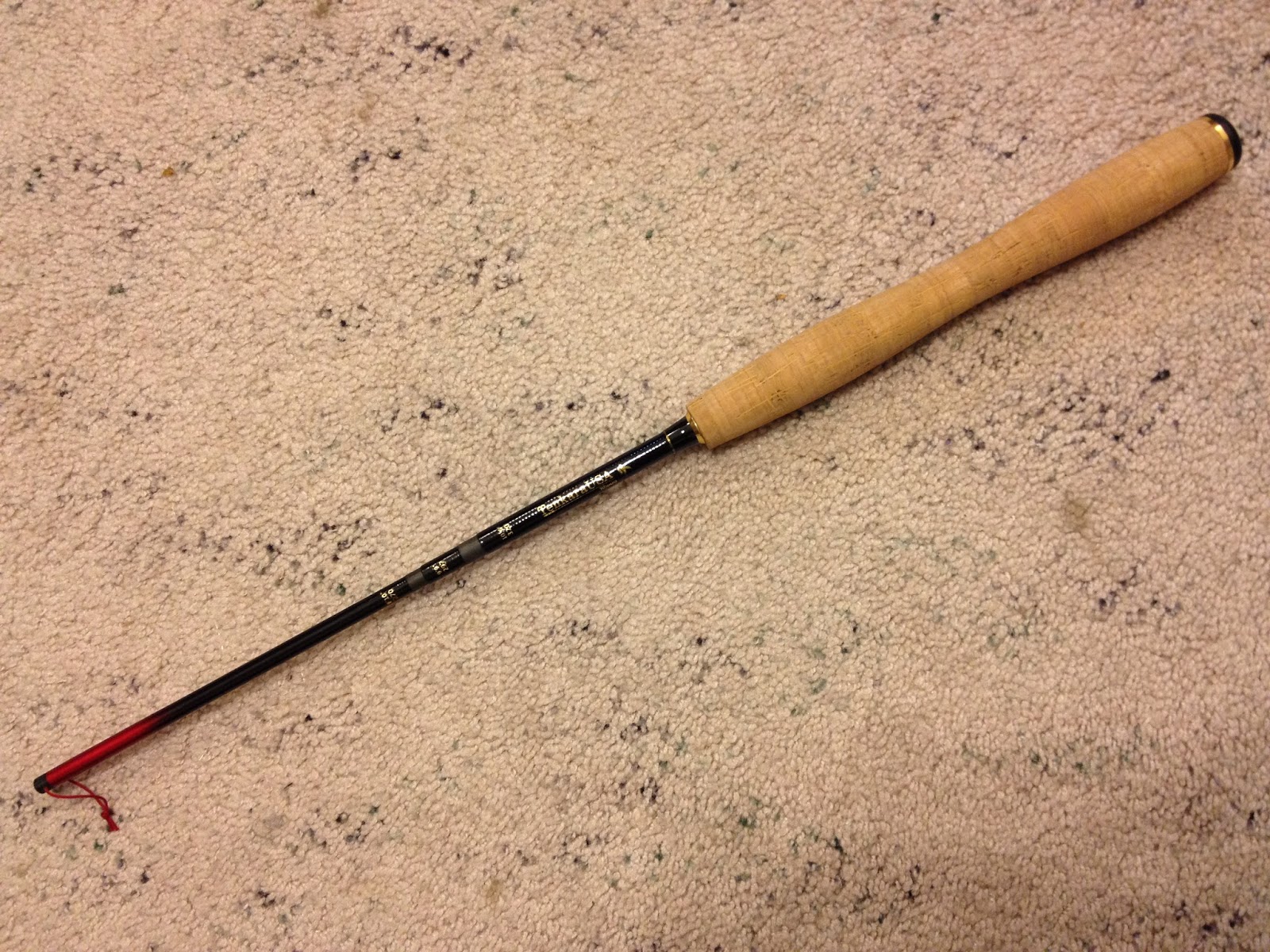
Tenkara USA Rhodo
This rod is Tenkara USA's shortest rod. In its shortest configuration it is 270 cm. It is well made, aesthetically pleasing, light in hand and has a very functional flex profile -- stiff enough for all but the largest fish in the tightest waters but not too stiff. It casts a #3.5 level line beautifully. One advantage is that it can be extended to 297, then 320 cm when fishing more open sections. Another is it's thoroughly thought out design. It is readily available from Tenkara USA. It is expensive compared to other short zoom rods, however.
The CCS values for the Rhodo are 15 pennies at 320 cm, 15.5 pennies at 297 cm, and 15 pennies at 270 cm. This gives it a RFI of 4.3, 5.2, and 5.6 for 320, 297, and 270 cm respectively.
------------------------------------------------------------------------------------------------------------------------

Nissin Pro Spec 2-way 320
This rod is very comparable to the TUSA Rhodo. It too is well made, has a very nice flex profile and casts a #3.5 line beautifully. In its short configuration it is 270 cm. It too will fight fish well in tight quarters, but it not too stiff to make casting unpleasant. It can be extended to 320 cm for more open sections. One advantage it has over the Rhodo is that the Pro Spec 2-Way 320 comes in two different flex ratings -- 6:4 and 7:3. Mine is a 7:3. Nissin rods seem softer in action that what is advertised. The 7:3 casts like a 6:4. I suspect the 6:4 casts more like a 5:5. Another potential advantage over the Rhodo is that it costs less and is made in Japan.
In the long position (320 cm configuration) the rod has a Common Cents System rating of 14.5 pennies. This gives it a Rod Flex Index rating of 4.6. In the short position the rod is 15.5 pennies, and thus an RFI of 5.6.
------------------------------------------------------------------------------------------------------------------------
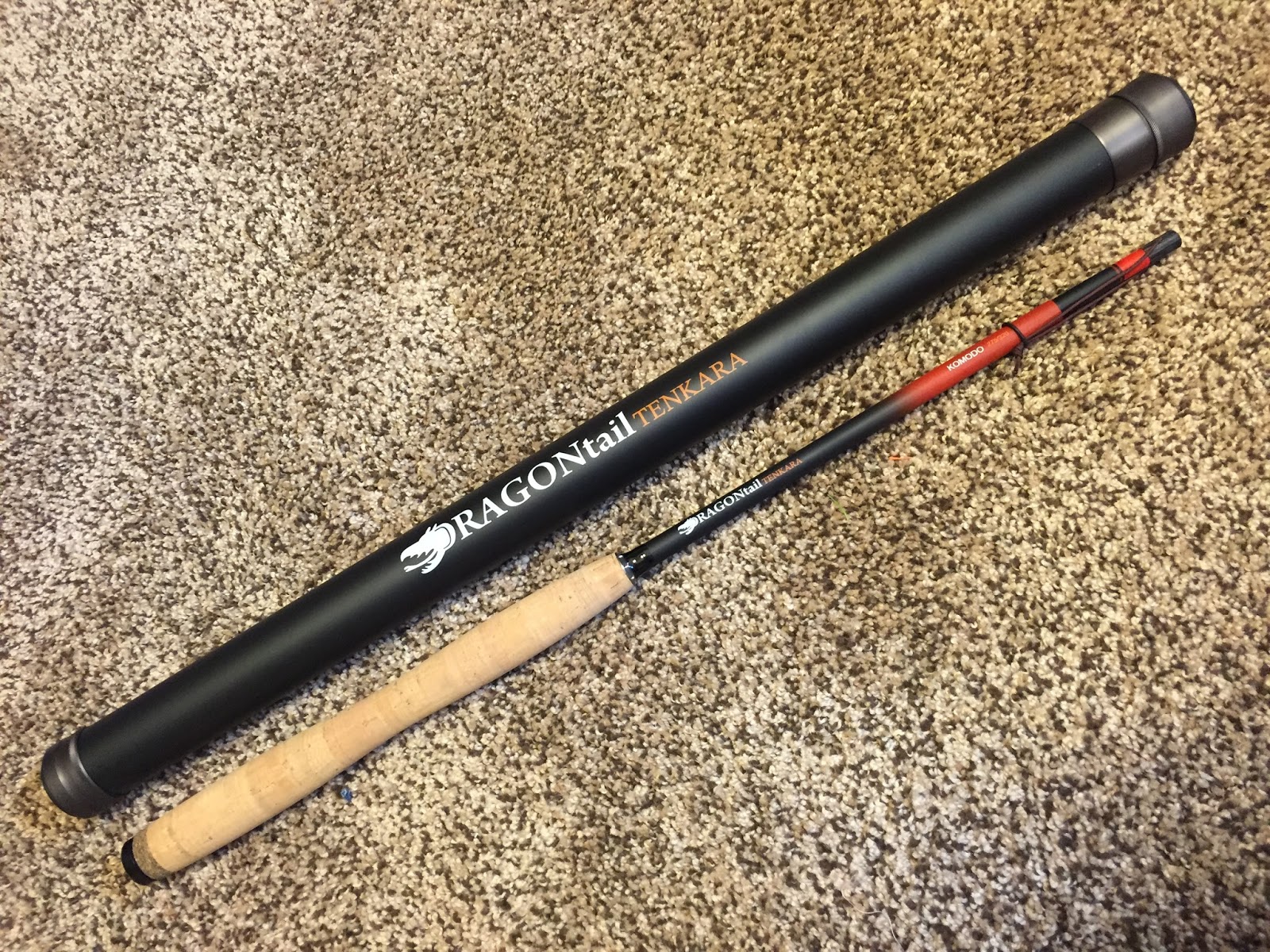
DRAGONtail Komodo
This is DRAGONtail's entry into the short rod scene. Like all of DRAGONtail rods, it seems well made with good quality components. It too is 270 cm at its shortest usable length and extends to 315 cm for more open areas. The finish is a pleasing flat graphite but the action is pretty stiff. It works best with a short furled line, but I find a furled line to be problematic when fishing small streams. Here's the argument. When fishing small streams you tend to snag the line a lot: in trees, in bushes, in underwater logs and rocks. If you step forward to retrieve the fly then you scare the fish. If you pull the snag out then the furled line tangles up. With a furled line you can spend a considerable amount of time unraveling the tangles. Besides, furled lines are heavy. I prefer level lines for small streams.
The CCS rating for 270 cm is 24 pennies; an RFI of 8.9. For its 315 cm it's 26 pennies; RFI of 8.3. That's pretty stiff.
------------------------------------------------------------------------------------------------------------------------

Nissin Yuyuzan 2-Way 290ZX
This is a short keiryu zoom rod that fishes in both 240 and 290 cm lengths, thus giving a tight quarters guy like me some choices. It has quite a flexible tip but it stiffens up pretty fast -- maybe too stiff for some. Being 240 cm, it allows even tighter creeks to be fished. I have a number a small streams that 270 cm is just too long -- you may be able to hook a fish using the sling shot cast but when you try to set the hook you find out you can't, you keep hitting tree branches. In spots like this a 240 cm rod can save the day.
I'm still not sure if I like this rod, as it's pretty stiff, but I really like it's lengths and how well it fights larger trout. At 240 cm it has a 19 penny rating (RFI 7.5). At 290 cm it is 22 pennies (RFI 7.4). Those numbers don't seem that stiff, but they don't tell you the truth: that the rod is stiff while the tip is very flexible. That's why the RFI numbers are in the mid-7's.
-----------------------------------------------------------------------------------------------------------------------

Tenkara Rod Company Cascade
This 240 cm rod is really stiff and inflexible. It is so stiff that traditional casting is a challenge. It does very well with the sling shot cast however. There are a couple of other things I don't like about it. First, it is bright blue. Maybe I'm fooling myself, but since short rods demand that you get really close to your quarry, you need to be even more stealthy than usual. This rod is anything but stealthy. It is so bright that you might as well have a sign above your head that says PREDATOR. Now, maybe that's not quite fair. After all, when I used the Cascade I caught plenty of fish. But still, I don't like the color.
The second down side is that this is sort of an expensive rod, given it's length. It costs more than some better rods and I'm not quite sure why.
On the Common Cents System it is a stiff 23 pennies. This gives this rod a very stiff Rod Flex Index of 9.6! That puts the rod well into the 8:2 action.
------------------------------------------------------------------------------------------------------------------------

Shimotsuke Kiyotaki 24 and 27
These little keiryu rods are far from the prettiest, but they have caught me more fish than all the rods previously mentioned -- combined. I have to say, these little guys are some of my favorites. They are inexpensive yet highly portable and very functional. They have a very useful flex profile and cast a short line well. They also have plenty of lower rod stiffness to fight the "big boys" out of the underwater snags. The walls of these rods are thin and I have broken two of them, both times my fault. The walls are not as thin as the Pocket Mini 270 but as with all rods, be careful pulling back hard.
The CCS rating for the Kiyotaki 24 is 15 pennies. That's a RFI of 6.3. The Kiyotaki 27 is a 20 penny rod. That's an RFI of 7.4.
--------------------------------------------------------------------------------------------------------------------------

Nissin Fine Mode Kosansui 270
This keiryu rod is a wonderful short rod for small streams. Of all the rods fore mentioned, I'd have to say this rod is the best balanced. It casts a short level line beautifully and is only 37 g in weight. It has a beautiful finish and top notch design. It is a little long when fully collapsed but hey, I can over look that. This is a great rod. If I didn't already have a Soyokaze I'd buy one of these rods.
It's CCS rating is 19 pennies. It's RFI is 7.0.
------------------------------------------------------------------------------------------------------------------------

All Fishing Buy Wakata 270
Yes, the Wakata. I don't know how many tenkara rods are sold per year, but I bet Allfishingbuy, the Staten Island internet fishing company with the funny name, sells a lot -- all over the world. A few years back when tenkara people were saying there was no such thing as a 270 cm tenkara rod, Allfishingbuy was selling them.
The Wakata is a nice rod. I like its flat black carbon finish and its flex profile. It is a little long when collapsed, the longest of all these rods, and the handle is a less than traditional is shape. But I like the rod. It's hard to beat the price and replacement parts are crazy cheap. If you want a short rod that is a workhorse and one that wouldn't make you cry if you broke it tripping over a log jam, then this is the rod. It has a CCS rating of 15 pennies and an RFI of 5.6.
-------------------------------------------------------------------------------------------------------------------------

Daiwa Soyokaze 270
Finally we come to the Soyokaze. This is the most amazing rod. It was my first 270 cm rod and has to be my overall favorite. It is light in the hand, is well balanced, and casts so beautifully in tight quarters. The tip is very flexible making modified roll casts a cinch, and sling shot casts a piece of cake. It is a little heavier than the Kosansui 270 but it is also a little beefier. Look around on the internet, the Soyokaze 270 has caught some pretty large fish -- into the upper teens. This rod is out of production, and those that own one are not likely to sell theirs. But if you ever see one come up for sale, buy it. Yeah, it's that good.
The Soyokaze 27 has a CCS of 17.5. It's RFI is 6.5. BTW, the Soyokaze 24 is a pretty great little rod too. It's CCS is 13 pennies, with an RFI of 5.4.
--------------------------------------------------------------------------------------------------------------------------
So there you have it, a few 270 or shorter rods for tight, brushy creeks and streams. Not every body likes this type of fishing since it is really hard and the fish are not usually very big. But I love this stuff. What's your poison: Henry's Fork for 20" browns on a #20 PMD dry or no-name creek, surrounded by willows, for 6-8 inch native cutthroats? I'll take the little creek any day, no questions asked. To me a short rod + a short line = maximum fun!
I'll be reviewing some other short rods soon, so stay tuned!
You can buy the rods I talked about from Tenkara Bum, Tenkara USA, Tenkara Rod Company, Dragontail Tenkara, Allfishingbuy, as well as some direct Japanese importers.