I've always found nymphing skinny water to be difficult. Around my part
of the country, winter usually brings the lowest flows of the year, as most of
the water is locked up in ice and snow. Still, there's some nice fishing to be
had.
In this outing I continue my exploration of the egg pattern. This is a
different river than where I fished the egg before, so I was curious to see if
it would still produce.
What a blessing it is to be a fly tier now days! One thing we don't have to worry about is finding good quality hooks. Unlike the old days, where there were a relatively few suppliers of quality hooks, now days we have a choice of hook suppliers - almost to many choices!
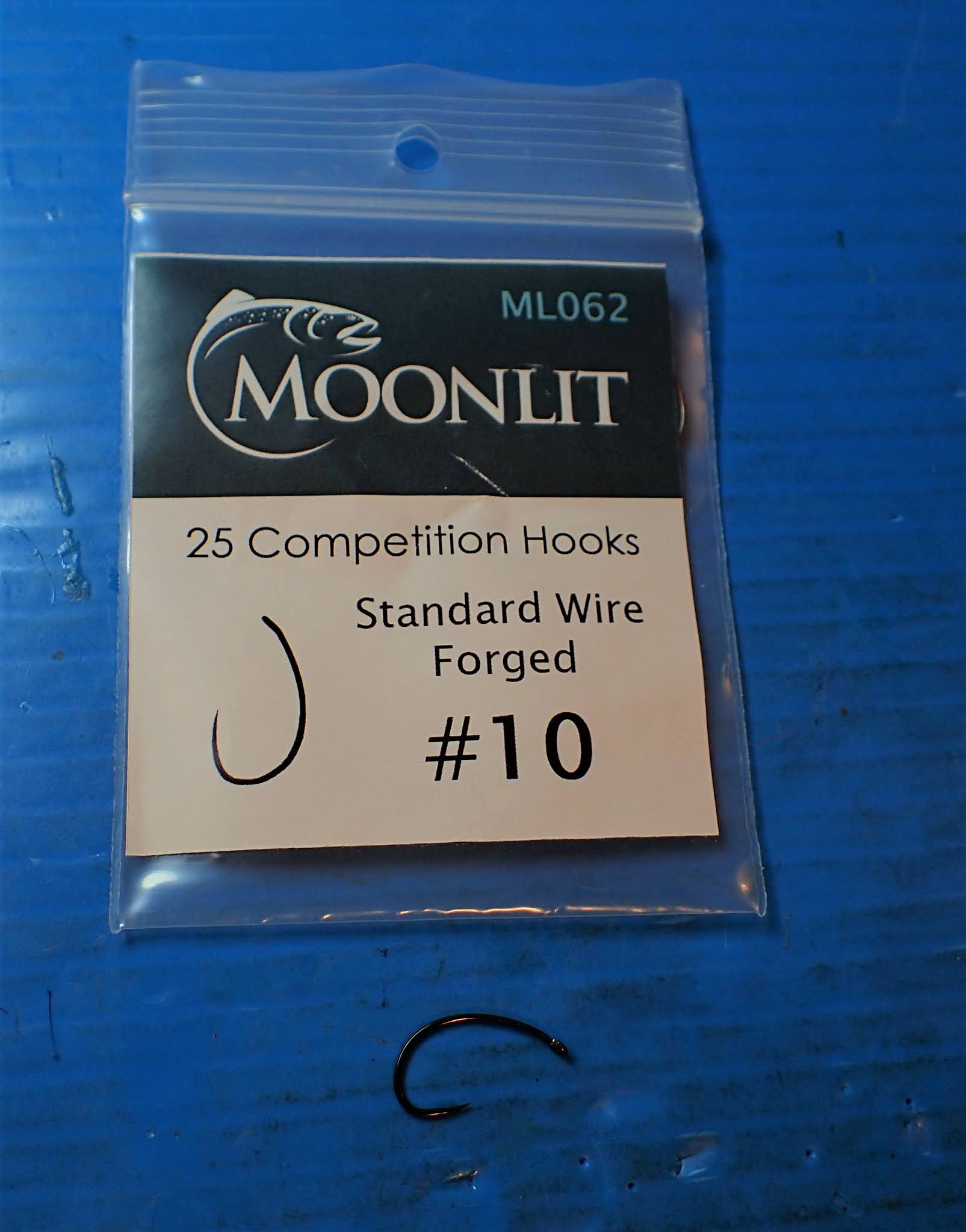
Recently, I've been tying with some new options for quality hooks. These hooks come from Moonlit Fly Fishing and I find them a pleasure to fish.
The first hook is the Moonlit ML062. I wrote about this hook back in September, and I've been using it more and more. This is a moderately heavy gauge, curved shank, competition barbless hook. It's got a straight eye and a slight "claw" at the hook point. I find that the hook sinks the kebari well, is strong, and sticks the fish soundly. I like the black coloration, the slight upward turn of the hook point, and the sink rate. At $0.21 per hook ($5.29/25), they fair well with options from other hook suppliers. Over the last few years, my favorite hook has been the Fulling Mill 35065, but at $0.26 per hook, they are expensive. The ML062 is a very nice replacement for the FM35065.
Another hook that I'm loving lately is the Moonlit ML251. This is one of Moonlit's Togatta line of hooks. These are premium Japanese made barbless hooks. They are chemically sharpened and very strong for their wire gauge. This hook has a slightly upturned eye, long needle point, straight shank, thin gauge wire, and black coloration. I like it for kebari I'm going to use in skinny water, as this hook has a slower sink rate. And yes, it is "wicked sharp"! At its current reduced price of $0.20 a hook ($9.99/50), it competes well with other hook suppliers. If they go back to the normal price of $12.00 per 50, the price per hook goes up to $0.24. That may not sound like a big increase, but that price increase would be enough for me to maybe overlook it for other options - maybe. It's still much less than the similarly designed Tiemco 206BL, which comes in at $0.37 per hook.
Brent and Brandon have really been coming through for tenkara anglers over the past few years with some excellent fishing and fly tying products, and these hooks are no exception! So, if you are looking for some great hooks for your fly tying, look no further than Moonlit Fly Fishing hooks. I really like them and think you will too!
I continue testing the egg pattern I've been using in the last few outings. It
seems to work well, at least on this stream, with these fish. I'll likely test
it on a different stream next, but for now, here's the video of me continuing
upstream:
I've been testing out the bead head egg pattern again, just to make sure
it wasn't a fluke. This is part I of a two part vlog using the egg
pattern. Turns out the egg pattern really does work well!
I recently was able to borrow a Pocket Ninja rod from Tenkara Tanuki. This rod
has been out a while and I've heard some good things about the rod.
Jason Klass
blogged about his impressions of the Pocket Ninja, as did
Anthony Naples. They both gave positive reviews.
Luong Tam, owner of Tenkara Tanuki, sent me some thoughts of his regarding the
goals for the Pocket Ninja. He states, "I am traveling about 30 to 50 thousand miles/ year for fishing, hiking,
trade shows, and fishing related events. I like to drive on backroads and
there are many fishing streams run along those 50 thousand miles. I also
do a lot of backpacking and hiking, high mountain stream fishing in
Eastern Sierra to catch wild native trout like the Golden trout, Lahontan
cutthroat. Most of those high mountain stream fish are not bigger than
12”, except on the outlets from lake where I can catch 20” monster horse
race monster brown. More importantly, I am a member of Oakland Casting,
Golden Gate Casting Club, Long Beach Casting Club, and Pasadena Casting.
It tells you, how much I am interested casting, and also I do spend more
time casting than catch fish. The casting ACTION FLEX is the most
important to me.
Design philosophy: Convenience : it fits inside glovebox, it is easy to
access “while driving” for the roadside fishing or on the hiking
trails. It is a fisher best friend. The rod much be compact, light weight,
and ergonomic. Casting experience and Playing high mountain native
fish is more importantly than controlling a big fish.
The Challenges: The Pocket Ninja development are in rod casting ACTION
FLEX, playing small fish FLEX, and strength for handling the good size one
in sloppy water of the Sierra. The rod is designed for catching 10"
mountain streams trophy. The rod can handle, a big fish, when
needed. For example, the biggest fish was 22” wild rainbow in Yellowstone
National Pack, 16” grass carp in Italy(early this month), 16” wild rainbow
in fast water in Yosemite.
I have been working with the rod engineers for a few years and testing
the rod at trade shows, fishing related events, casting club. The
prototypes were in my glovebox for more than a year. It is safe to say a
few thousand fish were caught on the roadside streams. I fished with all
kind of fly from #10 tungsten bead head to #20 Midge in winter."
So that gives you some idea of what kind of thought and sweat equity that went
into the design, and manufacturing of the Pocket Ninja. This is no off the
shelf, repainted Chinese rod. This rod is special.
Here is what I found:
The Tanuki Pocket Ninja 11' comes in a plastic rod tube, along with a nicely
designed rod sleeve. The overall coloration is carbon black, with a glossy
finish. The surface of each segment is unsanded, so there are the prominent
ridges of an unsanded blank as you would expect. The walls are thin and deform
slightly under moderate squeeze pressure, but not nearly as much as the
segments of the Nissin Pocket Mini rod.
There are prominent accents on the tip portion of each segment, excepting the
tip segment. These accents are Tanuki classic hunter orange, and really stand
out. If you are unfortunate enough to drop this rod while hiking, you'll have
a good chance of finding it again; those orange accents seem to almost glow!
The handle is 20 cm in length and is made of a non-slip material that works
well both wet and dry.
The tip plug is gold anodized metal with a nylon insert. It fits snugly, but
not completely, into the handle segment of the rod. It has a loop of lilian
material running through it. The butt cap is anodized metal, has a coin slot
and decompression hole. The edge is lightly knurled and there is an O-ring to
keep the cap in place.
The lilian is red and is joined to the tip segment with a perfectly executed
glue joint (see photo below). The entire rod can be disassembled for cleaning
and drying.
To see the RFI comparison chart in detail, click
HERE
and request the link.
As far as using the rod, the Pocket Ninja is balanced nicely, and has a quick,
moderate flex action. Tanuki states that the Pocket Ninja has a slow or soft
action, but I disagree. The Pocket Ninja has an RFI of 5, which puts is
solidly in the moderate flex action range. A soft action would be like the
Tanuki XL-1 (an excellent rod and one of most favorite tenkara rods) which has
an RFI of 3.9. An RFI of 5 is not slow or soft, it is moderate. The numbers
bear that out.
Now, I'm not dissing the Pocket Ninja, it's a very nice rod, with an excellent
action. In fact, I prefer rods that have an RFI of around 5; it's my perfect
flex action. With this flex action, the Pocket Ninja casts a tight loop, has a
brisk and confident hook set, and has great control when fighting fish. I
didn't hook anything large on the Pocket Ninja, but Anthony Naples did. Go
back and
read his review
again. Nice brown!
Anthony Naples and his really nice brown trout.
(Image stolen from his blog)
I fished the Pocket Ninja on a moderate sized stream and caught small
cutthroats. The rod threw my unweighted kebari perfectly. The Pocket Ninja is
a little short for the stream I tested it on, but all my small streams are
frozen over. In winter you do what you've got to do!
Here is a video of my on-the-water test:
Conclusion: the Tenkara Tanuki Pocket Ninja is a very nice rod!
It meets all Luong's design and function goals, as far as I can tell. It has
thoughtful design, excellent materials, very nice fit and finish, and spot-on
function. It would be an excellent rod for someone on the go, traveling,
biking, backpacking, or as a second carry rod.
I don't care for the trademark Tanuki hunter orange accents, but that's a
personal thing. Also, I am disappointed that the rod is billed as a 335 cm
(11') extended length, but is actually much shorter at 317 cm (10.4'). I
believe all the slip joints shorten the rod, but again, this is just a minor
complaint and shouldn't be interpreted as that big of a deal.
So, if you are in the market for a non-zooming, very compact, high quality
fixed line rod, I don't think you can do much better than the Tenkara Tanuki
Pocket Ninja!
Disclaimer: My opinion regarding this rod is just that, my
opinion. Your opinion may differ. Also, your rod may not have the
same length, issues, or functionality as my rod. There are variations
between rods, even in the same production run. No description can fully
tell you how a rod feels or fishes. For this, you must personally hold,
cast, and fish the rod then make up your own mind. I received no incentive or compensation from Tenkara Tanuki, and
there was no expectation of a favorable review of this product. I
was loaned the Pocket Ninja, and I returned it after this review.
Here is a video of another outing of contact nymphing I had a few weeks
ago. The weather, mainly the breeze, made line control less than ideal, but I
still had a great time. I used an egg pattern, which was new to me.
Using a dubbing hook is a great way to reinforce peacock herl on your
flies and kebari. It is simple to do, and works really well making a very
robust herl chenille! Here is a video where I demonstrate how I use the
dubbing hook.
Also on the video, I show how I hide the threads of my whip finish when I tie
a sakasa kebari. Most flies are whipped at the head, but I tie the head first
on a sakasa kebari and I whip behind the thorax. With a thread body sakasa kebari, that is no issue, but with a wool or other material abdomen it can leave a
prominent band of thread. That thread band is OK is you are using thread the same color as
the thorax or abdomen, but when you use thread of a different color, it can be
unsightly. I don't think the fish care, but I do! So in the video, I show how I hide the
whip threads with a little dubbing.
The field of view (FOV) of this video is non-traditional on purpose. It is to
allow you to see the loop formation and whipping technique better than the
standard fly tying view.
Let me know if you have any questions about either technique.
I published a blog post on June 5, 2020 calledBook of Favorite Flies, Vol. 1, where I talked about a book that I had made to record my favorite fly patterns. After that post was published, I received quite a few requests to buy the book. That book was made for me to document my kebari preferences, sort of like a journal, and was not designed for sale.
However, it got me thinking. I thought, why not make the book available to those who want a copy. But due to the cost of physical publishing, I thought an eDocument or eBook would be the best way to approach distribution.
Of course, I'm not a publisher, or even a very good writer. But I decided to put together a type of document that folks could purchase for a small fee and have on their electronic device for reference. So, I used Visme and created a linkable document.
This eDocument or eBook is volume 1, and contains 20 of the flies or kebari that I use most often. There is a color image of the fly, description of the materials used, and short comment regarding that particular fly. At the end of the eBook is a short tutorial on using a dubbing hook; a tool I find indispensable when tying certain patterns. The eDocument is in a scrollable format, from top to bottom, and the size of each page can be adjusted using a slider bar in the bottom right corner of the viewer screen.
The eBook costs $12 USD. That all.
So, if you are interested in getting the link to the eBook, go to the tab at the top of this page and click the tab labeled "Flies and Kebari Collection eBooks", (OR CLICK HERE) and thank you!
If you buy the book, let me know what you think! Did you find the book helpful? Would you like to see a second volume of my favorite flies and kebari? Think I'm a hack and have no business publishing a book of flies? Let me know!